Refresh Linux MIME handler cache
pingdotgg/t3code #8673 adds update-desktop-database between writing the Linux desktop entry and setting the URL-scheme default. Refresh failures are caught; a five-second timeout limits the exit wait.
Recommendation
Ready to merge. The fix is verified and CI is green.
No blocking implementation issue found. Focused tests, static checks and isolated Linux integration checks passed at 21a30a5ec4ae881d8ab3d094c1ec877881435cf2.
GitHub now reports MERGEABLE and CLEAN. The latest CI workflow passed: Test, Check, Release Smoke, Test Server 1–3 and Rust. Mobile Native Static Analysis was skipped after the native-change check. No merge or GitHub approval was performed.
What this solves
After signing in, a browser may return to T3 Code through a t3code:// callback link. Linux can know that T3 Code is the default and still show an empty application chooser because its application-discovery cache does not contain T3 Code.
This PR refreshes that cache. Linux can then discover and offer T3 Code as the application for the callback link.
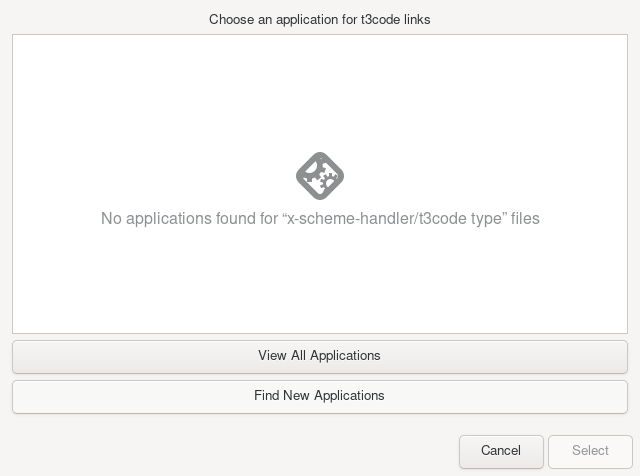
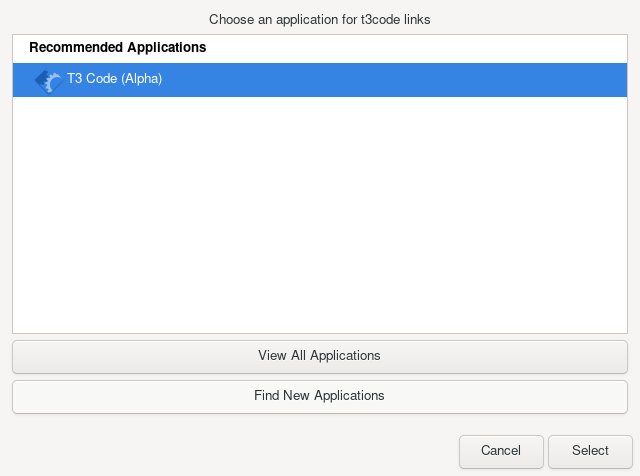
Actual GTK 3 application-chooser screenshots, captured on an isolated X display. Each state was generated by executing the corresponding version of T3 Code’s registration service with real filesystem/process services. The dialog queries x-scheme-handler/t3code; its explanatory heading was set by the test harness. These are not mockups or screenshots of a complete OAuth login. Both use the same test executable and isolated XDG directories; only the registration implementation differs.
Before & after: real Linux discovery
Executed the actual registration service with real Node filesystem/process services and Debian desktop-file-utils 0.26 plus xdg-utils 1.1.3. Each case used separate temporary XDG data/config directories. GIO queried the resulting scheme registration.
Before — base ba79610d16
xdg-mime default: com.t3tools.T3Code.desktop
GIO default: com.t3tools.T3Code.desktop
No registered applications
No recommended applications
mimeinfo.cache: absent
After — PR head 21a30a5ec4
xdg-mime default: com.t3tools.T3Code.desktop
GIO default: com.t3tools.T3Code.desktop
Registered applications:
    com.t3tools.T3Code.desktop
Recommended applications:
    com.t3tools.T3Code.desktop

[MIME Cache]
x-scheme-handler/t3code=com.t3tools.T3Code.desktop;
gio open dispatched a synthetic t3code://oauth/callback?code=pr8673-test&state=isolated URL intact as one argument to a temporary handler executable whose path contained a space. A socket receipt confirmed delivery; no real OAuth account or installed T3 instance was used.
Verification
| Scenario | Result |
|---|---|
| Focused URL-handler and pre-ready platform tests | 13/13 passed across two files. |
| Desktop typecheck; changed-file lint and formatting; diff check | All passed. |
| Successful refresh and URL dispatch | Cache populated; GIO discovers handler and delivers complete URL. |
| Existing desktop entry | Repeat registration preserved nanosecond modification time. |
| Missing update-desktop-database | Warning logged; xdg-mime still recorded the default. |
| Refresh exits with status 7 | Warning contains exit code; default registration continues. |
| Real stalled refresh process | Registration completed in 5,031 ms; spawned child no longer existed; default recorded. |
| Development mode | Entry written; no cache refresh or default registration. |
| macOS and Windows guards, simulated on Linux | No handler directory created. |
| Write failure; xdg-mime failure; executable fallback | Covered by the passing focused suite. |
Commands: vp test run src/app/DesktopLinuxUrlHandler.test.ts src/app/DesktopPreReadyPlatform.test.ts from apps/desktop; vp run --filter @t3tools/desktop typecheck; targeted vp lint and vp fmt --check. No repo-wide suite was run locally.
Merge risk & limits
Low implementation risk. The added subprocess runs only for packaged Linux registration. A missing or failing utility leaves discovery unfixed but preserves the existing default-setting path. A stalled utility adds roughly five seconds to startup before registration continues.
The production code preserves the dynamic desktop-entry name, pre-ready write and unchanged-content check requested in the earlier review. The remaining review nit is test hardening: unit tests record writes and commands separately rather than asserting their combined order. The real integration run confirmed the correct final cache contents.
Surface coverage: desktop Linux startup applies. Web, mobile, provider adapters, wire contracts, Settings/command palette entry points and remote connection paths are unchanged. macOS/Windows exclusion was tested through environment guards, not native execution. No documentation change is needed for this fix.
Not exercised: a complete OAuth round trip in a packaged Electron build or each browser’s portal integration. The screenshots verify the native GTK chooser’s before/after behavior. The separate GIO dispatch test verifies delivery to an isolated executable, not account login.
Source files were not edited. Temporary harnesses, MIME utilities, XDG fixtures and local screenshots are removed after publishing; isolated X displays were stopped. No dev server was started; live user state and URL-handler defaults were not changed.